As the heat is slowly fading away into autumn, new processes emerge, leaving seasonal traces.
See what changes!
Pile Fest (Day I)
27.09.26
15:00–19:30
Next up
Looking at how seasons, humans, and more-than-human communities intermengle, we gather at the pile to investigate once more what has changed.
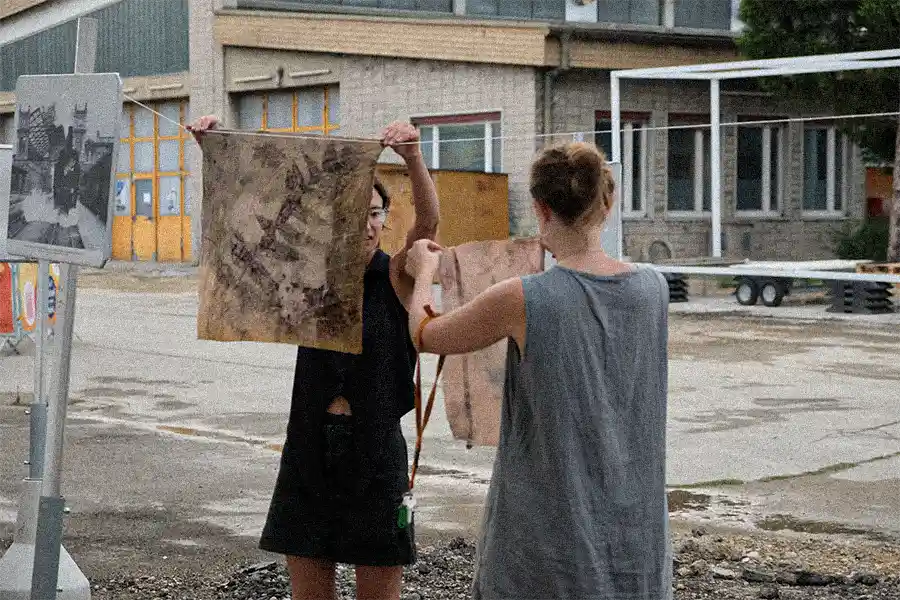
We invite you to join us to move together on the pile, see what grows, ceased to do so, or emerged anew, and create a banner from plant-printed fabric patches (created at our plant-printing workshop earlier this summer).
-
Practicing the Pile: Movement15:00–16:00
-
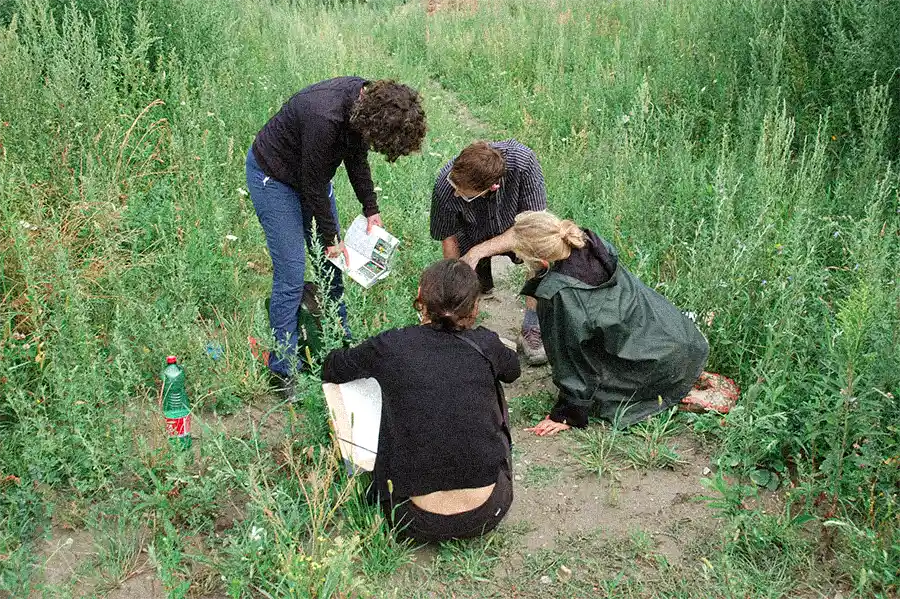
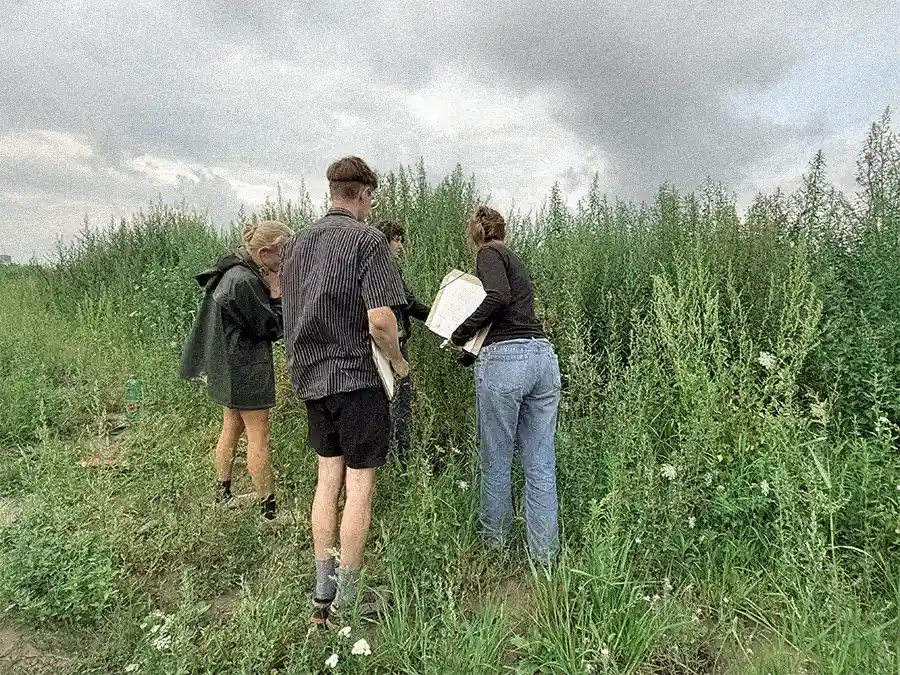
Plant ID: drawing and collecting16:00–17:30
-
Banner making, picnic, and readings17:30–19:30
Past events
-
Meanderings: Film Screening02/08/26
What happens when we let our thinking wander to other places, beyond the pile? By engaging with two short films about rivers, waste, and flooding, we open spaces to think together about riverine landscapes. Together with @re_fract_, we immerse ourselves in multitudes of life forms – human and more-than-human, anthropogenic changes, pollution, and the multiple futures of climate change that rivers are entangled with.
Pile (48°12’05.8”N 16°26’50.9”E)
-
Reading Circle and Plant ID workshop29/07/26
-
Practicing the Pile: Movement28/07/26
-
Practicing the Pile: Movement21/07/26
-
Plant Printing and banner making17/07/26
In this hands-on workshop we will create textile banners using plant dyeing and plant printing as a form of collaborative expression and textile activism. We focus on two ecologically special places that have been shaped by the Danube and are about to disappear – Pocketpark Nordwest and the post-flood sediment pile on Vienna’s Danube Island.
Museum Nordwestbahnhof
-
Reading Circle and Plant ID workshop16/07/26
-
Practicing the Pile: Movement14/07/26
-
Practicing the Pile: Movement07/07/26
-
European Bauhaus Festival9–12/06/26
-
Precipitate: Kick-off Event20/05/26
-
Whole in One04–05/26
Between April and May 2026, Post Flood Community participated in (Whole) in One as part of Tracing Spaces’ contribution to the Klima Biennale Wien. See you for a round of cross-golf at the Pocketpark Nordwestbahnhof on these dates!
Museum Nordwestbahnhof
In September 2024, a low-pressure system named Boris brought record-breaking rainfall to central Europe, causing severe flooding across the Danube River Basin. Vienna was spared from damage — the retention basins of the Neue Donau, and the flood protection barrier the Donauinsel, absorbed the flood wave. But this wave carried more than water. It carried aquatic and terrestrial critters, chemicals and materials, including millions of tonnes of fine sediments remobilised from behind the ~700 dams and weirs that break the Danube and its tributaries upstream. As the flood waters receded, over 100,000 tonnes of these sediments were deposited in Vienna.
Fine sediments are the skeletal mass of the river, stretching across every stream, tributary and floodplain through which the river is fed and flows. They are formed from the meltwaters and scree of high Alpine glaciers, from the wastewater infrastructures of cities and industry, and from the soils of agricultural plains. They hold the material and metabolic history of the river’s territory. These sediments nourish the river’s floodplains, sustain its delta, and replenish vital coastal structures and subaquatic entities in the Black Sea. Today, barely a third of the Danube's fine sediments reach these destinations. The rest remain trapped behind dams, or — like the deposits in Vienna — stranded on sealed land that was once floodplains.
Fine sediments are usually suspended in the body of the river and are therefore difficult for us to see or touch. The 2024 flood was one of the few moments when the river moved fine sediment past the embankments and left a trace in the city. This post-flood material is evidence of a river trying to do what it has always done — shape the ground through which it flows — even though today this landscape is engineered to prevent exactly that.
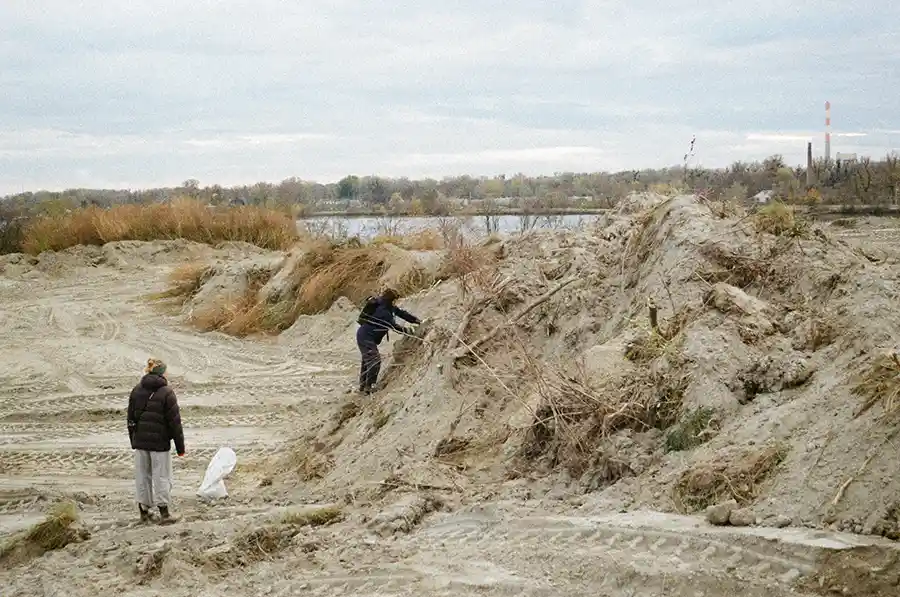
Between October and November 2024, the MA45 (Wiener Gewässer), responsible for land management on the Donauinsel, cleared the stranded sediment from public paths and roads and swept 70,000 m³ of it into a pile at river kilometre 1929. Since the spring of 2025, Post Flood Community has observed this pile transform from a wet aqueous mass of river material into a thriving aquatic-terrestrial biotope rich with urban plant and animal life. Yet the regulatory management protocols of Vienna transform the pile once more. It is currently being excavated for its use in construction projects, and in 2027 the pile will ‘convert’ to waste, resulting in its removal and disposal in landfill. We ask, what would it mean to treat post-flood deposits as something the river is giving us, rather than as waste the City must clear away?
Rather than treating the pile as a heap of post-flood waste, Post Flood Community approaches the pile as a natureculture learning place — an opportunity for collective observing, caring, experimenting, sharing knowledge about riverine transformations and challenges, and accompanying ecological and administrative processes on site. Over the summer of 2026, Post Flood Community will host a programme of workshops, performances, discussions and screenings in collaboration with the pile and its interlocutors. Together with artists, river scientists, land managers, residents and the multispecies communities of the pile, we will explore what post-flood landscapes can teach us about coexistence, resilience, ecology and the future of living with the Danube in this age of accelerating environmental change.
About
Team
Post Flood Community is an interdisciplinary arts and design-based group that has gathered around this question. Over the duration of the pile’s second growing season, from May to September 2026, we are hosting a participatory research programme at the pile. Together we will learn to read a flood deposit that contains the material memory of an entire river system. What grows on the pile is a record of what the Danube is still carrying — not just minerals and chemicals but propagules, seeds and rhizome fragments from upstream floodplains, from riverbanks that were inundated, from wetlands that no longer exist in their original form. The entities shaping the pile’s ecology are both a record of what the river still connects to upstream, and a record of how river processes are entangled with the ecologies and metabolisms of the city.